
Week of May 4, 2026

Published every Monday: Get a detailed snapshot of what moved the markets last week—and what to watch this week.

Earnings soar, markets follow.

Strong earnings reports helped the U.S. stock market continue to rally. The Nasdaq Composite and S&P 500 led the way, and the small-cap Russell 2000 also finished higher for the sixth consecutive week. Fixed income markets were lower as the Federal Reserve (Fed) remained data-dependent when considering interest rate cuts.

Weekly Quick Hits

Beyond the Headlines

Earnings soar, markets follow.

Report Releases

First-quarter GDP snapped back to 2 percent despite higher oil prices in March.

Financial Market Data

The Nasdaq led markets higher; the Russell 2000 rose for the sixth week in a row.

Looking Ahead

The April employment report on Friday is this week’s highlight.

BEYOND THE HEADLINES:

Earnings Soar, Markets Follow

Over the past few years, headlines have often driven markets lower—sometimes quickly. But over the long term, it’s fundamentals that determine the path of stocks.

We’re seeing this now. Despite the ongoing conflict in the Middle East and no clear path to restore stable oil flows to global markets, equities are at record highs. The reason? Impressive corporate earnings growth.

On Pace for an Impressive Quarter
On March 31, as the first quarter ended, analysts expected earnings growth to increase 13.2 percent, similar to the previous four quarters in 2025.

With more than 60 percent of first-quarter earnings season complete, corporate results have been outstanding. Earnings growth for the S&P 500 is averaging 27.1 percent, an impressive number that is striking considering the headwinds—especially tariffs and surging oil prices—companies have faced over the past year. If that level holds, it would be the best growth rate seen since the fourth quarter of 2021. It would also mark the sixth consecutive quarter of double-digit earnings growth.

Participation Strong Across Sectors
Encouragingly, growth has been widespread, with 9 of 11 sectors reporting earnings growth. This suggests broad sectors of the economy are faring relatively well, which is a shift from the technology-heavy growth experienced in recent years. That said, the recent move higher in earnings growth was due in large part to reports from technology firms Alphabet, Amazon, and Meta Platforms. Nonetheless, growth across nine sectors is encouraging for corporate America and a positive sign for a healthy market. Full-year 2026 earnings estimates have risen 5.6 percent since the Middle East conflict began—and second-quarter estimates have moved higher as well.

Markets at Record Highs
The S&P 500 fell 9 percent from its February high to its March low because of uncertainty about how the Middle East conflict would affect long-term economic fundamentals. Since then, the market has rallied 14 percent. The ongoing ceasefire has allowed investors to refocus their attention on fundamentals. With corporate America delivering the strongest quarter of earnings growth in almost five years, investors have responded.

Risks always exist, and volatility is still possible. But strong earnings growth should provide underlying support for markets over the long term.  


“Earnings growth for the S&P 500 is averaging 27.1 precent, an impressive number that is striking considering the headwinds-especially tariffs and surging oil prices- companies have faced over the past year.  

Report Releases: April 27–May 1, 2026

Conference Board Consumer Confidence Index:
April (Tuesday)

Consumer confidence rose despite expectations that it would decline. Consumers’ views on the future of the economy improved due to the ceasefire in the Middle East.

  • Expected/prior month consumer confidence: 89.0/92.2
  • Actual consumer confidence: 92.8

Federal Open Market Committee (FOMC) Rate Decision:
April (Wednesday)

As expected, the Fed left rates unchanged after its April FOMC meeting.

  • Expected/prior federal funds rate upper limit: 3.75%/3.75%
  • Actual federal funds rate upper limit: 3.75%

Advance GDP Annualized:
First Quarter (Thursday)

Economic growth picked up, with GDP rising 2 percent on an annualized basis in the first quarter. Although this report was slightly below expectations, it was a solid improvement from the fourth quarter.

  • Expected/prior quarter GDP growth: +2.3%/+0.5%
  • Actual GDP growth: +2.0%

Personal Spending and Personal Income:
March (Thursday)

Personal income improved in March; spending growth was in line with estimates. Strong spending was due in part to rising gas prices.

  • Expected/prior personal income monthly change: +0.3%/+0.0%
  • Actual personal income change: +0.6%
  • Expected/prior personal spending monthly change: +0.9%/+0.6%
  • Actual personal spending change: +0.9%

Institute for Supply Management (ISM) Manufacturing Index:
April (Friday)

Manufacturing activity missed expectations, remaining unchanged last month. But the good news is this marked four consecutive months that the index has been in expansionary territory.

  • Expected/prior ISM Manufacturing index: 53.2/52.7
  • Actual ISM Manufacturing index: 52.7


The Takeaway


  • First-quarter GDP snapped back after a slow-growth fourth quarter.
  • Consumer confidence improved last month, and personal income and spending rose in March.

Financial Market Data

Equity

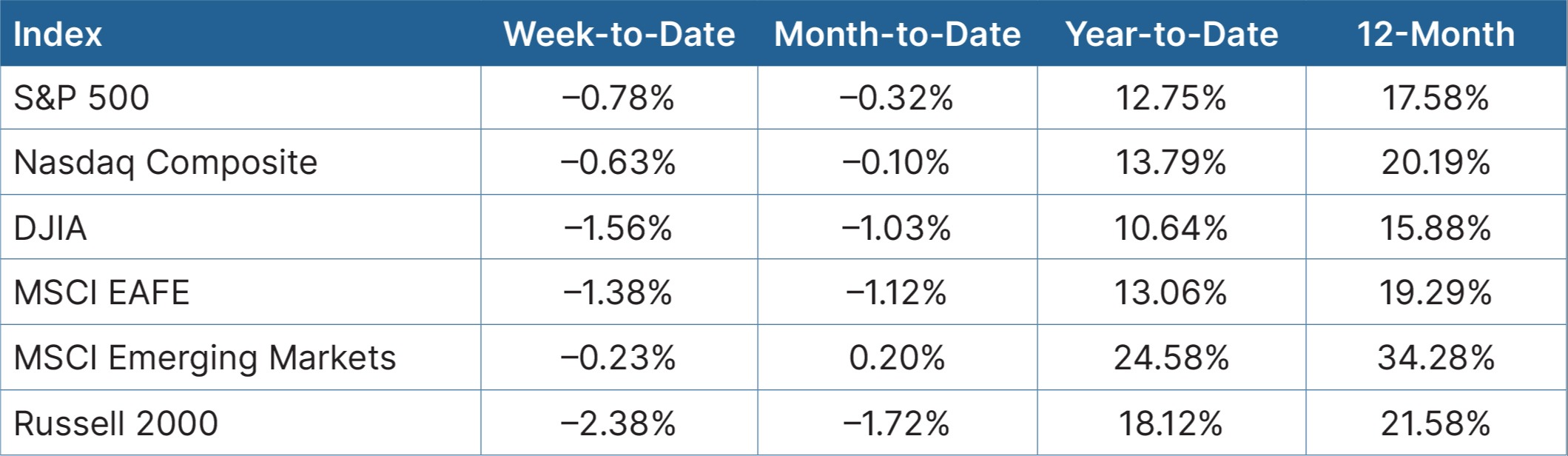
Markets were modestly higher. The Nasdaq Composite again led the way, rising more than 1 percent. It was the fifth consecutive positive week for the Nasdaq and the S&P 500. The small-cap Russell 2000 Index was up for the sixth consecutive week. From a sector standpoint, communication services and energy fared best, rising 4.5 percent and 3.2 percent, respectively. Materials was the only sector to decline, falling almost 2 percent. International markets were flat; developed markets rose slightly and emerging markets dipped.

Equity graph

Fixed Income

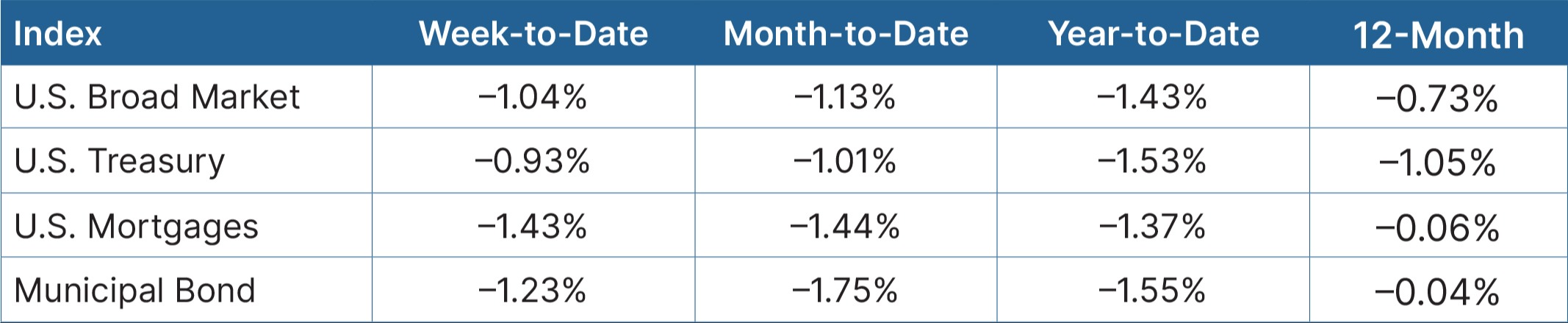
Fixed income markets were marginally lower. Despite the Fed leaving rates unchanged, Treasury yields rose across the board as markets reacted to comments about the future path of rates. The 10-year increased 7 basis points (bps) to 4.38 percent. High-yield and municipal bonds were down slightly.

Fixed income graph

The Takeaway


  • Stocks continued to rally as investors focused on fundamentals. Corporate earnings remained strong, supporting the rally.
  • Fixed income markets were marginally lower as yields across the Treasury curve increased. Fed comments about the path of interest rates were the biggest driver.
Looking Ahead Image

Looking Ahead

An update on the labor market will be the key economic report this week. After job creation snapped back in March, expectations are that fewer jobs were created in April.

  • The week kicks off Tuesday with the ISM Services index for April. Expectations are that service sector confidence will decline for the second month in a row.
  • On Friday, we’ll see the April employment report. After a relatively strong March, it’s expected that hiring will slow to 63,000 jobs.
  • Also on Friday, we’ll receive the University of Michigan consumer sentiment survey for May. Sentiment is expected to decline again, potentially reaching a new low.
  • Earnings reports continue throughout the week, with the focus shifting to consumers. Highlights include reports from Pfizer, Disney, McDonald’s, and Uber.

Disclosure: This material is intended for informational/educational purposes only and should not be construed as investment advice, a solicitation, or a recommendation to buy or sell any security or investment product. Diversification does not assure a profit or protect against loss in declining markets, and diversification cannot guarantee that any objective or goal will be achieved. Please contact your financial professional for more information specific to your situation.

Bonds are subject to availability and market conditions; some have call features that may affect income. Bond prices and yields are inversely related: when the price goes up, the yield goes down, and vice versa. Market risk is a consideration if sold or redeemed prior to maturity.

Certain sections of this commentary contain forward-looking statements that are based on our reasonable expectations, estimates, projections, and assumptions. Forward-looking statements are not guarantees of future performance and involve certain risks and uncertainties, which are difficult to predict. All indices are unmanaged and are not available for direct investment by the public. Past performance is not indicative of future results. The S&P 500 is based on the average performance of the 500 industrial stocks monitored by Standard & Poor’s. The Nasdaq Composite Index measures the performance of all issues listed in the Nasdaq Stock Market, except for rights, warrants, units, and convertible debentures. The Dow Jones Industrial Average is computed by summing the prices of the stocks of 30 large companies and then dividing that total by an adjusted value, one which has been adjusted over the years to account for the effects of stock splits on the prices of the 30 companies. Dividends are reinvested to reflect the actual performance of the underlying securities. The MSCI EAFE Index is a float-adjusted market capitalization index designed to measure developed market equity performance, excluding the U.S. and Canada. The MSCI Emerging Markets Index is a market capitalization-weighted index composed of companies representative of the market structure of 26 emerging market countries in Europe, Latin America, and the Pacific Basin. The Russell 2000® Index measures the performance of the 2,000 smallest companies in the Russell 3000® Index. The Bloomberg US Aggregate Bond Index is an unmanaged market value-weighted performance benchmark for investment-grade fixed-rate debt issues, including government, corporate, asset-backed, and mortgage-backed securities with maturities of at least one year. The U.S. Treasury Index is based on the auctions of U.S. Treasury bills, or on the U.S. Treasury’s daily yield curve. The Bloomberg US Mortgage Backed Securities (MBS) Index is an unmanaged market value-weighted index of 15- and 30-year fixed-rate securities backed by mortgage pools of the Government National Mortgage Association (GNMA), Federal National Mortgage Association (Fannie Mae), and the Federal Home Loan Mortgage Corporation (FHLMC), and balloon mortgages with fixed-rate coupons. The Bloomberg US Municipal Index includes investment-grade, tax-exempt, and fixed-rate bonds with long-term maturities (greater than 2 years) selected from issues larger than $50 million. One basis point is equal to 1/100th of 1 percent, or 0.01 percent.

Authored by the Investment Research team at Commonwealth Financial Network®.

© 2026 Commonwealth Financial Network®

Let’s Talk About Your Financial Future

Whether you’re navigating a volatile market or preparing for the future, we’re here to help.

Schedule a Consultation